Welcome to Japanese Nepali Laboratory
Thank you for using Japanese Nepali laboratory jpnplab.com "Exploring Japanese Language and Culture" is website for learning Japanese language and culture necessary for daily life in Japan. Learn anytime, anywhere, at your pace. Let's get started!
Index
Introduction to Pronunciation
Japanese accent refers to specific points of pitch ↑↓ in a word. Japanese word has many homophones and in conversation, listener distinguish between these homophones by word accent.
For example, in written language Japanese distinguish between 花 (हाना / फूल) and 鼻 (हाना / नाक) using Kanji, in conversation it's unclear which "हाना" is meant. Therefore, Japanese words add accents to distinguish between words.
Japanese has various accents depending on region, however here is explain using the Tokyo accent as an example. This Tokyo accent is standard accent for Japanese, characterized by a definite change in pitch between the first and second syllables. Accent points are explained using two types of high and low pitch. Only high and low can be a hard to image, so in here add Nepal's "Sargam" scale for reference. Sargam is a classical music scale widely used in Nepal and India and other. In Japan, it is known as दो रे मि फा सो रा सि in English countries it is known as CDEFGAB scale. In here, using Sargam "सा (Sa) ग (Ga)" of the सा (Sa) रे (Re) ग (Ga) म (Ma) प (Pa) ध (Dha) नि (Ni) to indicate high and low pitch.
Japanese word must distinguish between flowers and noses on such subtle differences, It takes practice for your ears to get used to accent. It not need to memorize of every word. Just only remember that there are differences accent.
Accents are divided into three types. And, there are four types of accents where a particle attached. First, learn the three basic types and get used to differences in accent. Then used to it, move on to the word + particle accent. Using vocabulary from Minna no Nihongo, this explain several accents.
Rising Accent
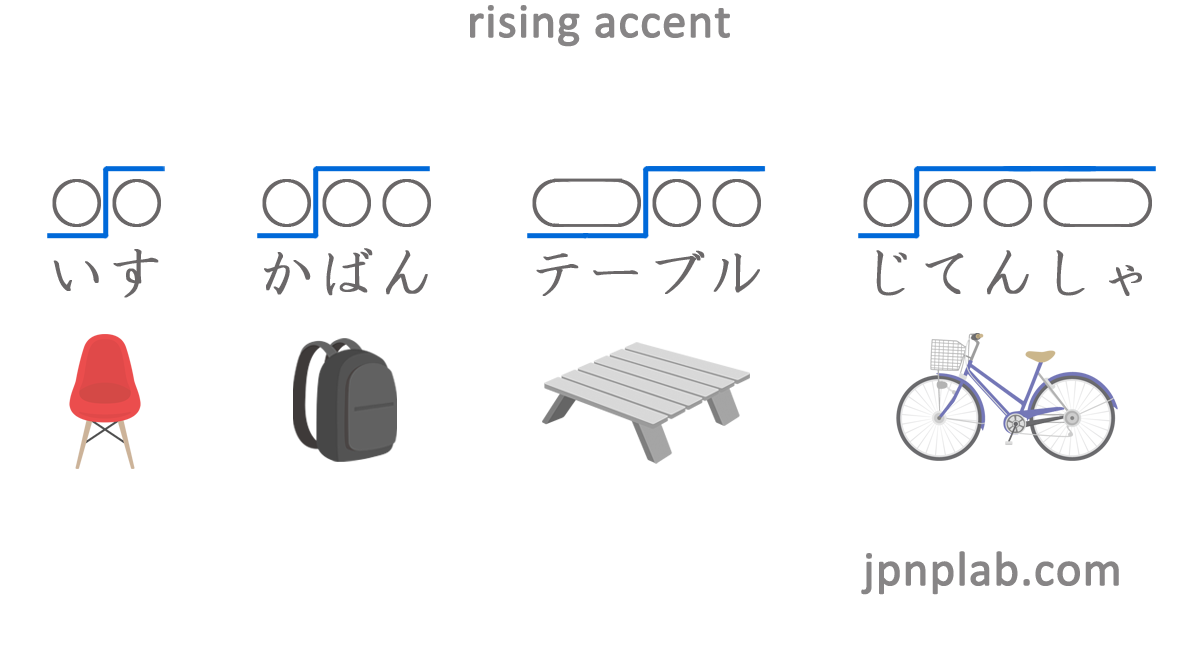
The "rising accent" type is pronounced with only the first syllable low, and after all syllables high. Furthermore, once an accent rises it never falls.
Dropping Accent
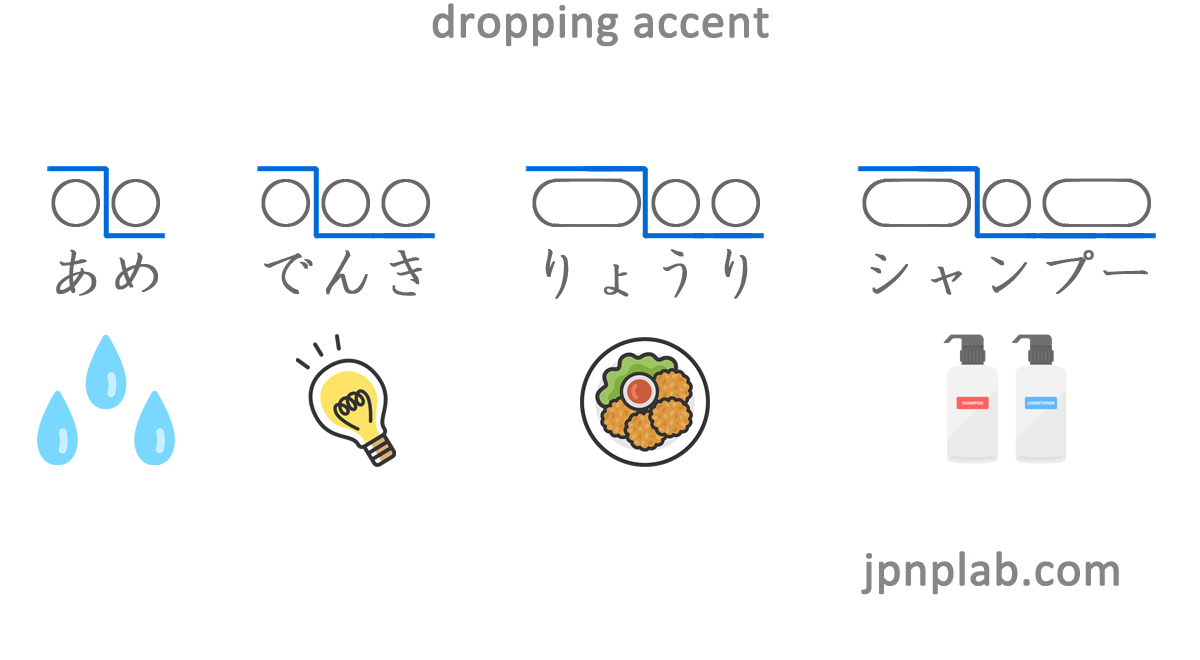
The "dropping accent" type is pronounced with only the first syllable high, and after all syllables low.
This blue underline is "accent nucleus" The accent nucleus is syllable immediately preceding point where pitch drops abruptly, this point of sudden descent serves as a crucial element in distinguishing word meanings.
※notice "र्यो"-री and "स्या"म्पू- is two characters, but as it is a यो-ओन् (also know as combination small ゃ ゅ ょ) it is two characters one sound.
Pahar Accent
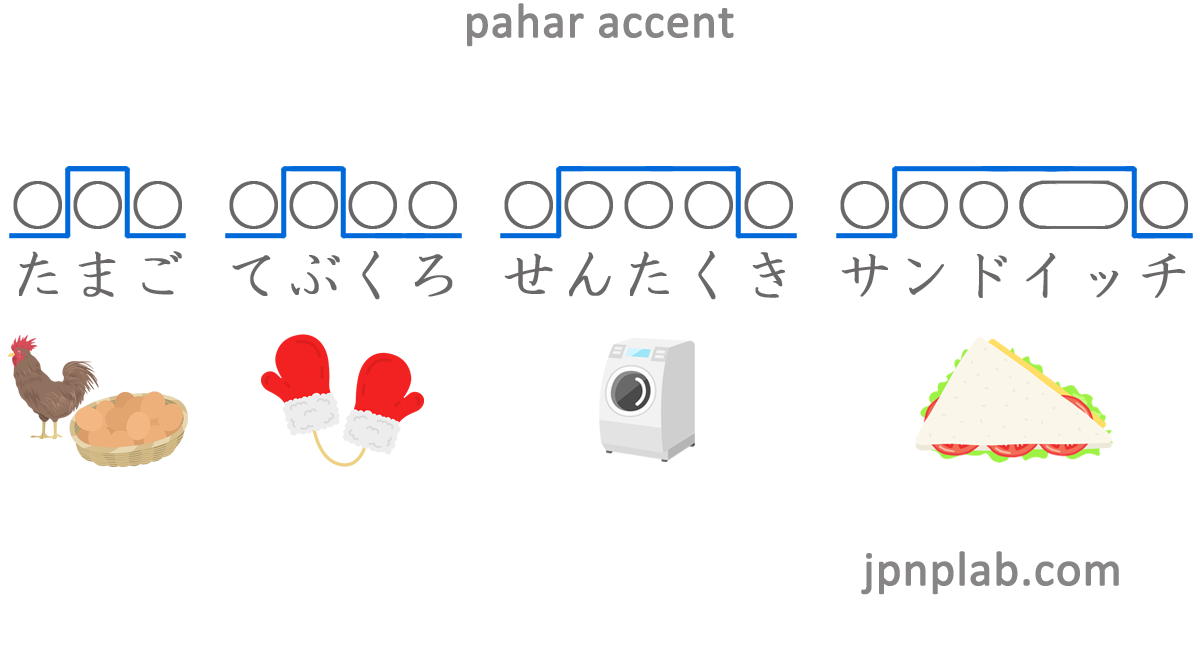
The "pahar accent" type is pronounced with only the first syllable low, and second syllables high, and once more low like a shape of mountain. Blue underline falling from high to low represent "accent nucleus" so pronounce them with conscious attention.
Rising Accent + Particle
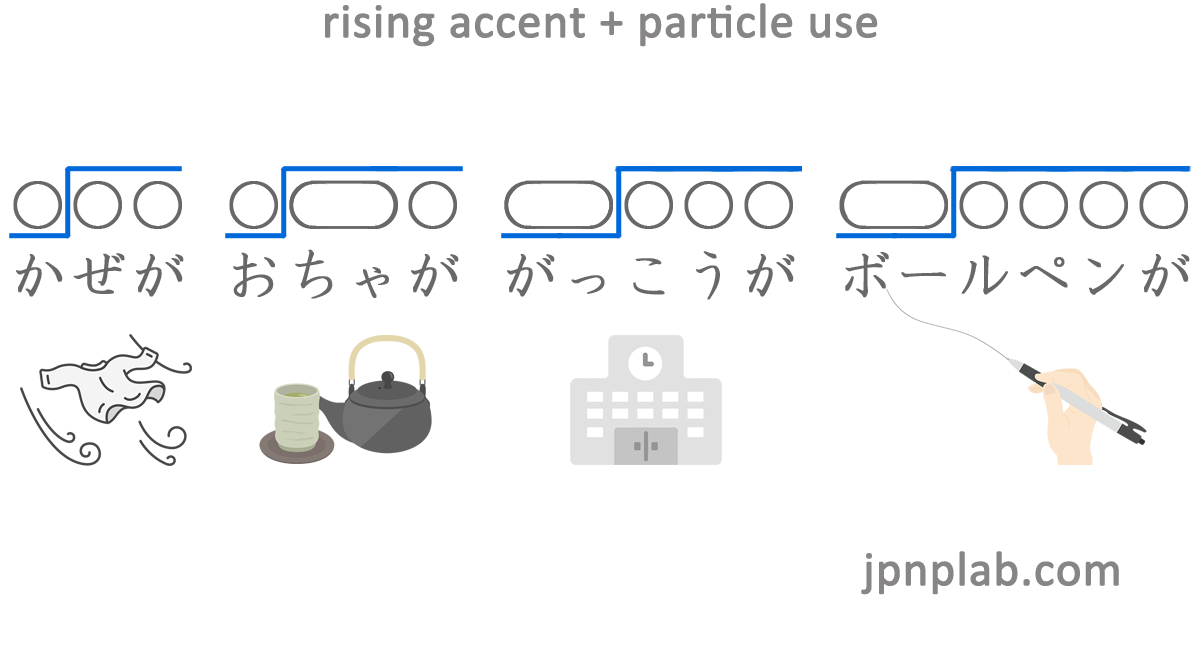
"rising accent + particle use" is conjugated rising accent type. Only the first syllable low, and after all syllables high.
Ankush Accent + Particle
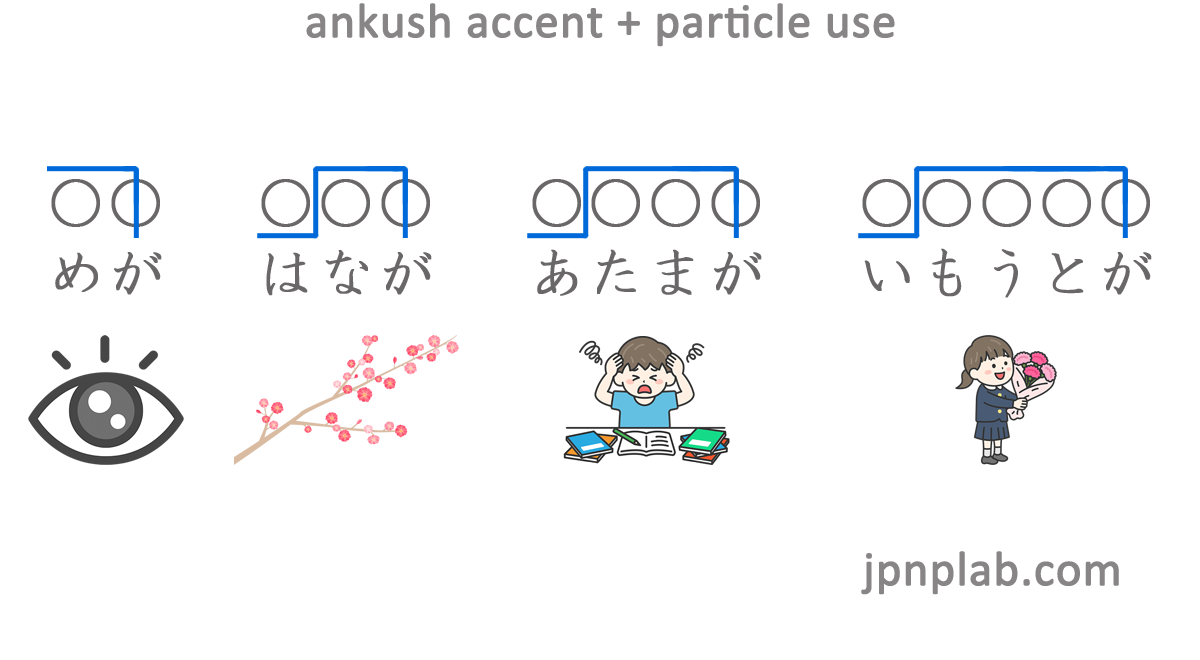
"ankush accent + particle use" is like rising accent. Only the first syllable low, and second third high, but final particle syllable drops suddenly.
※notice conjugated forms of particles use in rising accent, as final syllable will be high or low.
Dropping Accent + Particle
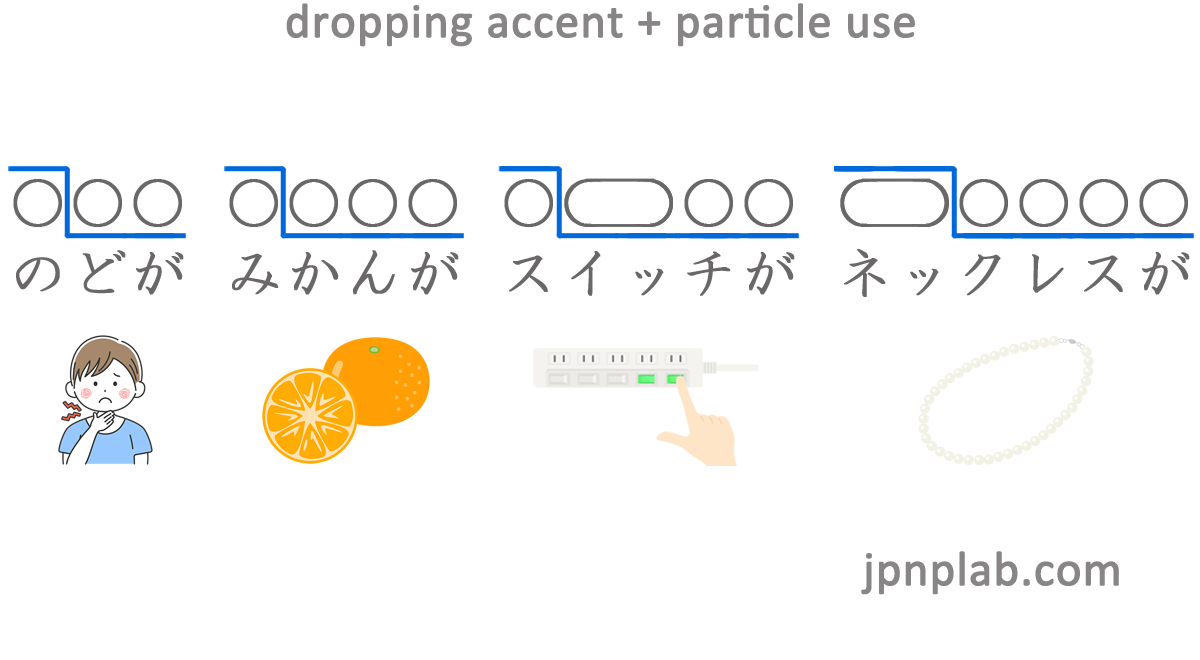
"dropping accent + particle use" type is pronounced with only the first syllable high, and after all syllables low.
※notice सुइच्ची can be different pronounced with accent depending on region like "H H L / ग ग सा" but both pronunciations are correct.
Pahar Accent + Particle
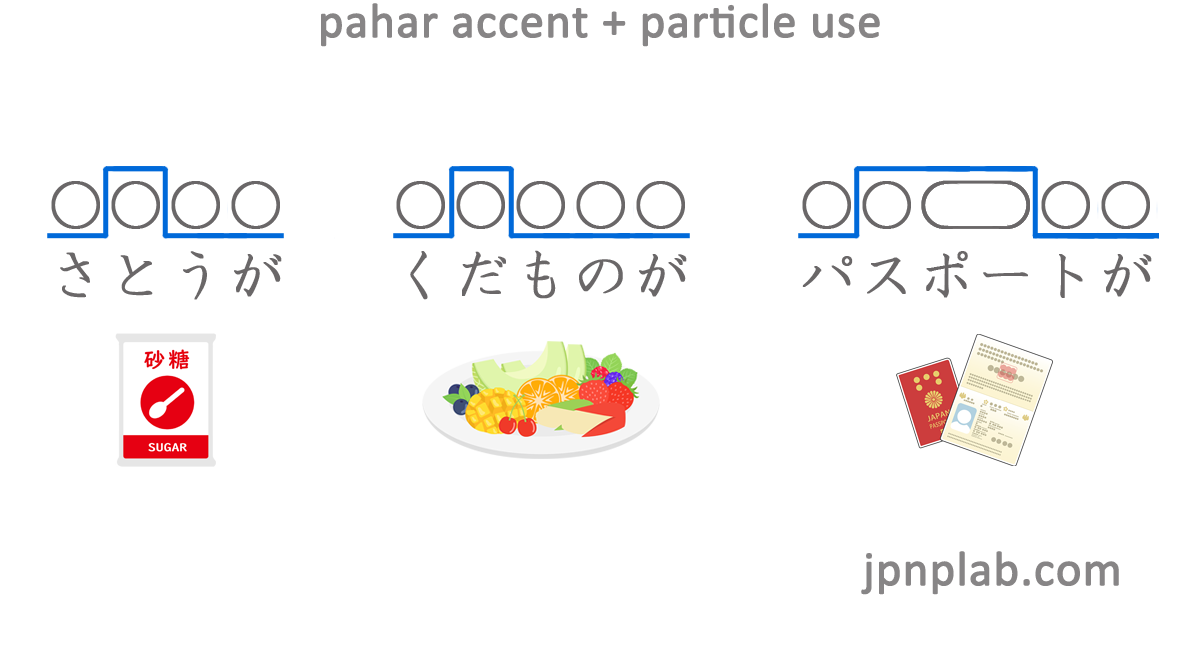
"pahar accent + particle use" type is pronounced with only the first syllable low, and second syllables high, and once more low. The falling part from high to low is accent's peak point, so pronounce it with a little bit strong. Continuing on pronunciation, let's move forward to Japanese nasal sounds.
Japanese has various accents depending on region, however here is explain using the Tokyo accent as an example. This Tokyo accent is standard accent for Japanese, characterized by a definite change in pitch between the first and second syllables. Accent points are explained using two types of high and low pitch. Only high and low can be a hard to image, so in here add Nepal's "Sargam" scale for reference. Sargam is a classical music scale widely used in Nepal and India and other. In Japan, it is known as दो रे मि फा सो रा सि in English countries it is known as CDEFGAB scale. In here, using Sargam "सा (Sa) ग (Ga)" of the सा (Sa) रे (Re) ग (Ga) म (Ma) प (Pa) ध (Dha) नि (Ni) to indicate high and low pitch.
Japanese word must distinguish between flowers and noses on such subtle differences, It takes practice for your ears to get used to accent. It not need to memorize of every word. Just only remember that there are differences accent.
Accents are divided into three types. And, there are four types of accents where a particle attached. First, learn the three basic types and get used to differences in accent. Then used to it, move on to the word + particle accent. Using vocabulary from Minna no Nihongo, this explain several accents.
Rising Accent
The "rising accent" type is pronounced with only the first syllable low, and after all syllables high. Furthermore, once an accent rises it never falls.
Dropping Accent
The "dropping accent" type is pronounced with only the first syllable high, and after all syllables low. This blue underline is "accent nucleus" The accent nucleus is syllable immediately preceding point where pitch drops abruptly, this point of sudden descent serves as a crucial element in distinguishing word meanings.
※notice "र्यो"-री and "स्या"म्पू- is two characters, but as it is a यो-ओन् (also know as combination small ゃ ゅ ょ) it is two characters one sound.
Pahar Accent
The "pahar accent" type is pronounced with only the first syllable low, and second syllables high, and once more low like a shape of mountain. Blue underline falling from high to low represent "accent nucleus" so pronounce them with conscious attention.
Rising Accent + Particle
"rising accent + particle use" is conjugated rising accent type. Only the first syllable low, and after all syllables high.
Ankush Accent + Particle
"ankush accent + particle use" is like rising accent. Only the first syllable low, and second third high, but final particle syllable drops suddenly.
※notice conjugated forms of particles use in rising accent, as final syllable will be high or low.
Dropping Accent + Particle
"dropping accent + particle use" type is pronounced with only the first syllable high, and after all syllables low.
※notice सुइच्ची can be different pronounced with accent depending on region like "H H L / ग ग सा" but both pronunciations are correct.
Pahar Accent + Particle
"pahar accent + particle use" type is pronounced with only the first syllable low, and second syllables high, and once more low. The falling part from high to low is accent's peak point, so pronounce it with a little bit strong. Continuing on pronunciation, let's move forward to Japanese nasal sounds.
Japanese has various accents depending on region, however here is explain using the Tokyo accent as an example. This Tokyo accent is standard accent for Japanese, characterized by a definite change in pitch between the first and second syllables. Accent points are explained using two types of high and low pitch. Only high and low can be a hard to image, so in here add Nepal's "Sargam" scale for reference. Sargam is a classical music scale widely used in Nepal and India and other. In Japan, it is known as दो रे मि फा सो रा सि in English countries it is known as CDEFGAB scale. In here, using Sargam "सा (Sa) ग (Ga)" of the सा (Sa) रे (Re) ग (Ga) म (Ma) प (Pa) ध (Dha) नि (Ni) to indicate high and low pitch.
Japanese word must distinguish between flowers and noses on such subtle differences, It takes practice for your ears to get used to accent. It not need to memorize of every word. Just only remember that there are differences accent.
Accents are divided into three types. And, there are four types of accents where a particle attached. First, learn the three basic types and get used to differences in accent. Then used to it, move on to the word + particle accent. Using vocabulary from Minna no Nihongo, this explain several accents.
Rising Accent
"rising accent" type is pronounced with only the first syllable low, and after all syllables high. Furthermore, once an accent rises it never falls.
Dropping Accent
"dropping accent" type is pronounced with only the first syllable high, and after all syllables low. This blue underline is "accent nucleus" The accent nucleus is syllable immediately preceding point where pitch drops abruptly, this point of sudden descent serves as a crucial element in distinguishing word meanings.
※notice "र्यो"उरी and "स्या"म्पू- is two characters, but as it is a यो-ओन् (also know as combination small ゃ ゅ ょ) it is two characters one sound.
Pahar Accent
"pahar accent" type is pronounced with only the first syllable low, and second syllables high, and once more low like a shape of mountain. Blue underline falling from high to low represent "accent nucleus" so pronounce them with conscious attention.
Rising Accent + Particle
"rising accent + particle use" is conjugated rising accent type. Only the first syllable low, and after all syllables high.
Ankush Accent + Particle
"ankush accent + particle use" is like rising accent. Only the first syllable low, and second third high, but final particle syllable drops suddenly. ※notice conjugated forms of particles use in rising accent, as final syllable will be high or low.
Dropping Accent + Particle
"dropping accent + particle use" type is pronounced with only the first syllable high, and after all syllables low.
※notice सुइच्ची can be different pronounced with accent depending on region like "H H L / ग ग सा" but both pronunciations are correct.
Pahar Accent + Particle
"pahar accent + particle use" type is pronounced with only the first syllable low, and second syllables high, and once more low. The falling part from high to low is accent's peak point, so pronounce it with a little bit strong. Continuing on pronunciation, let's move forward to Japanese nasal sounds.
Next, Introduction to Grammar
Follow Us
Ourtranslate Changelog Contact Us
FAQS Terms & Conditions Privacy Policy
© 2025 jpnplab.com All Right Reserved